Category Growth and Buyer Behavior
Jewelry and accessories have become one of the top three categories on TikTok Shop across the US, UK, and Southeast Asia, with category gross merchandise value more than tripling in the past eighteen months. The average order value sits between 18 and 35 USD — lower than Amazon or Shopify jewelry stores — but the volume is driven by impulse discovery, creator recommendations, and live-selling events that can move thousands of pieces in a single two-hour stream.
TikTok buyers skew younger (18 to 34 is the dominant cohort) and shop emotionally rather than intentionally. They rarely search for "silver ring" — instead, they buy pieces they see worn by creators whose aesthetic they already follow. This fundamentally changes which SKUs succeed: visual drama and immediate wearability matter more than technical specs.
What Is Actually Selling
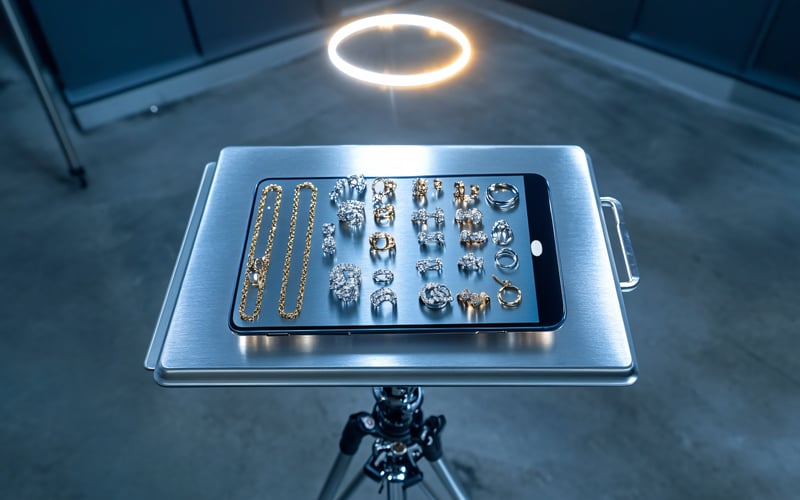
Three product families dominate TikTok Shop jewelry in 2026. First, dainty stacking pieces — thin chain rings, micro-pave tennis bracelets, and layered necklaces priced between 15 and 40 USD — built for the stack-your-vibe content format. Second, chunky gold statement pieces: thick Cuban chains, dome rings, oversized hoop earrings, almost all in brass with PVD gold plating, priced 25 to 60 USD. Third, a pearl revival driven by Gen Z reinterpretation: baroque pearl chokers, pearl and chain mixes, and asymmetric single-pearl earrings, often retailing around 30 to 50 USD.
On the flip side, traditional solitaire pendants, small matching sets, and grandmother-style aesthetics consistently underperform. Cubic zirconia solitaire rings that perform well on Amazon do not translate — TikTok buyers want pieces with personality and silhouette, not discreet classics.
Live-Selling SKU Strategy
Successful TikTok Shop sellers use a barbell SKU strategy: a small number of hero pieces (5 to 10 SKUs) drive 70 percent of revenue, while a broader long-tail catalog creates the sense of discovery that keeps viewers watching. Hero SKUs need deep inventory — live sessions routinely sell 500 to 2,000 pieces of a single item in an hour, and a stockout mid-stream kills momentum and hurts your shop rating.
Build your sourcing around this pattern: order deep on proven hero SKUs with six to eight week lead times locked in with your factory, and rotate long-tail SKUs in smaller quantities (100 to 300 pieces) to test trends. Tag every SKU with its live-event performance — pieces that sold well on stream deserve faster replenishment and a promotion to evergreen catalog status. Buyers who treat TikTok as an always-on trend sensor rather than a one-off promotional channel consistently outperform the category average.